 ultimate-guide
Destination Wedding Tips for the Smoky Mountains
Last Updated: November 1, 2026
Quick Summary
A mountain destination wedding works best when you choose the venue first, then secure permits, build a named backup plan for weather, and send guests one clear logistics document. Start planning six to nine months out for popular dates and sites, working backward from the ceremony.
- Confirm any ceremony permit with the National Park Service before committing to a site.
- Work backward from the ceremony, starting six to nine months out for popular dates.
- Write down who makes the weather call and what triggers a move to the backup.
- Pick a specific, already-permitted covered backup space that holds your guest count.
- Send one guest logistics document two to three weeks before the wedding.
Table of Contents
- Choosing a Mountain Venue That Fits Your Ceremony
- Planning Your Mountain Wedding Timeline
- Mountain Wedding Weather Tips and Backup Plans
- Guest Travel, Attire and Accessibility
- Mountain Wedding Packing List for the Couple and Guests
- Booking Your Officiant and Marriage License in Tennessee
- Frequently Asked Questions
Choosing a Mountain Venue That Fits Your Ceremony
Choosing the right mountain destination wedding venue is the single decision that shapes everything else, from permits to guest logistics. Start with the feeling you want, then narrow the location.
Cabins, overlooks and waterfalls compared
Each option trades privacy, access and flexibility differently. A cabin gives you a controlled space, shelter from weather and room for a small group, though many rentals book months ahead and limit ceremonies on their grounds.
A practical test: picture the ceremony, then picture the walk from parking to the spot with your shoes, your officiant and an older guest in tow.
Permits and rules for national park ceremonies
Ceremonies inside Great Smoky Mountains National Park generally require authorization, and rules change, so confirm current requirements with the National Park Service before you commit to a site. The National Park Service Great Smoky Mountains official site lists current guidance on special events and commercial use. Our site has a full walkthrough of the process in our 7 Steps to Get Your Smoky Mountain Wedding Permit, and the current requirements for elopements are spelled out in our Smoky Mountain Elopement Permit Requirements guide.
Planning Your Mountain Wedding Timeline
A workable timeline starts about six to nine months out for popular dates and sites, and it works backward from the ceremony. Secure your location and any permit first, because those dates limit everything else. Book your officiant early, then confirm your marriage license, then fill in vendors, attire and travel for guests. Last-minute ceremonies are possible, but they leave you with fewer choices, so an early plan protects your options.
Build a simple timeline with three checkpoints: the venue or permit confirmed, the license obtained and the final walkthrough completed the week before. Missing the first checkpoint is the most common reason couples end up scrambling.
Mountain Wedding Weather Tips and Backup Plans
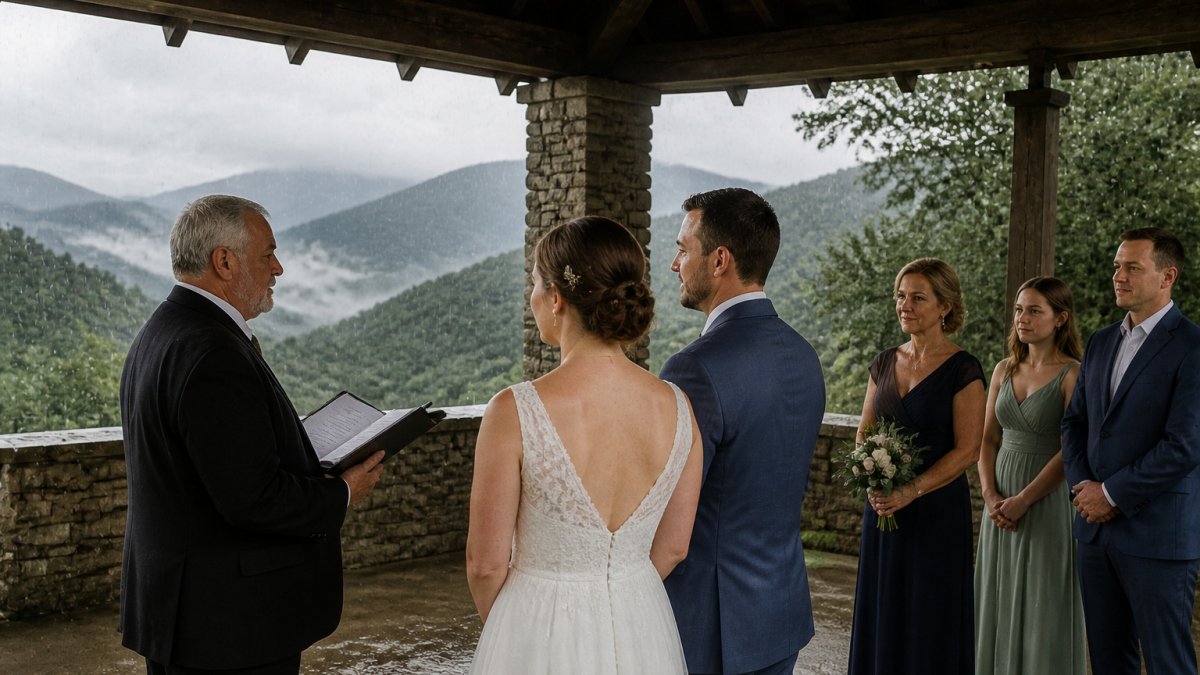
Mountain weather is the single biggest planning variable, and the Smokies are a textbook case: fog, rain, wind and temperature swings can all arrive within the same hour. Treat weather as a design constraint, not a surprise. The couples who handle it best build three things into the plan before they book anything: a named backup location, a written decision timeline, and a guest communication plan.
Build a decision timeline, not a single call
Write down who makes the final call and how guests will be told, a group text, a sign at the trailhead, or a note at the lodging. Decide in advance what triggers a move: steady rain, lightning within a set radius, sustained wind that makes a veil or arch unsafe, or smoke that obscures the view. Having the trigger written down removes the emotional debate on the day.
Name a real backup, not a vague one
"We'll figure it out" is not a backup. A usable backup is a specific, already-permitted space with a roof and enough seating: a cabin great room or covered porch, a pavilion, a lodge event room, or a covered overlook. Confirm with the venue or land manager that the backup is allowed, that it holds your guest count, and that you can move decor into it quickly.
Plan for wind, temperature swings and smoke
Wind is the most underrated mountain hazard: it topples arches, snaps lightweight signage, and makes candles and loose decor unusable. Weight your arch, skip open-flame candles, and use weighted linens and sturdy place cards. Wildfire smoke is a real seasonal possibility; build a smoke trigger into your decision timeline and keep the indoor backup ready, and check local air quality guidance from AirNow in the days before the ceremony.
Altitude, acclimatization and guest health
Elevation is the health issue most couples overlook. Guests arriving from lower elevations can feel short of breath, headachy or fatigued, especially on the first day and especially on steep paths to an overlook.
Permits, restrictions and leave-no-trace
Weather planning overlaps with rules: many public-land sites limit capacity, restrict setup, ban open flames during fire restrictions, and require a special-use authorization for ceremonies. Confirm current requirements with the land manager before you commit, for ceremonies inside Great Smoky Mountains National Park, start with the National Park Service Great Smoky Mountains official site. Build leave-no-trace into the plan: pack out decor, skip confetti and rice, and use existing paths rather than cutting new ones.
The article lays out the key weather-planning steps couples should build in before booking, which are summarized below.
| Planning step | What to do | Why it matters |
|---|---|---|
| Decision timeline | Write down who decides and what triggers a move | Removes emotional debate on the day |
| Named backup | Choose a specific, already-permitted covered space | "We'll figure it out" is not a backup |
| Wind | Weight the arch, skip open-flame candles | Wind topples arches and snaps signage |
| Temperature swings | Pack layers for the couple and guests | A 70°F afternoon can drop to 50°F at elevation |
| Wildfire smoke | Add a smoke trigger and check AirNow | Smoke can obscure the view |
| Altitude | Give guests a day to adjust and keep walks short | Guests may feel short of breath or headachy |
Guest Travel, Attire and Accessibility
Guest logistics are where mountain weddings quietly succeed or fail. The setting is the draw, but the drive, the parking, the walk and the altitude are what guests actually remember. Treat travel as a checklist you own, not a detail you delegate to a website link.
Airports, drives and travel buffers
Mountain roads are slower than the map suggests: winding two-lane routes, switchbacks and seasonal traffic can add significant time. Build a buffer into every leg, arrive a day early, schedule the ceremony mid-day rather than at dusk, and tell guests the realistic drive time, not the optimistic one. Check road conditions and closures before travel days; the National Park Service road status page is the place to start for park routes.
Parking, shuttles and the last mile
Parking at trailheads and overlooks is limited and often fills early. Decide in advance whether guests drive themselves, meet at a central lot and shuttle, or park at the lodging and walk. If you use a shuttle, confirm the pickup time, capacity and return schedule in writing, and give guests a phone number for the day. For remote sites, a shuttle is often the difference between a smooth arrival and a stressed one.
Accessibility and inclusive planning
Accessibility should be planned, not assumed. Confirm whether a site has paved access, benches, restroom facilities and a short, level walk from parking. For guests who cannot hike or handle high elevation, offer alternatives: a lower-elevation ceremony site, a seated viewing area, a golf-cart or shuttle transfer where allowed, and a clear invitation to skip the walk without missing the day.
Attire and what to tell guests
Dress guidance prevents most discomfort. Mountain weather calls for layers, and sturdy shoes are essential for gravel, roots and uneven ground. Tell guests the terrain and the walk length, suggest closed-toe shoes and a light jacket, and note that temperatures drop in the evening. Keep a spare set of shoes in the car for anyone who wears dress shoes on the trail.
Vendor coordination and local sourcing
Remote sites complicate vendor logistics. Confirm delivery access, setup time, power availability and a weather-safe staging area with each vendor, and favor local vendors who know the roads and the weather patterns. Build a setup buffer and a teardown plan, and give every vendor the same weather decision timeline you gave your guests.
Mountain Wedding Packing List for the Couple and Guests
Pack for the couple first. Include the marriage license and identification, rings, vow copies, a weather layer for each person, a small first-aid kit, water and snacks. For guests, suggest a light jacket, closed-toe shoes, sunscreen and a rain layer. Keep a spare set of shoes in the car for anyone who wears dress shoes on the trail.
Booking Your Officiant and Marriage License in Tennessee
Tennessee marriage licenses are issued through county clerk offices, so confirm current details with the clerk in the county where you plan to marry. Our step-by-step guide to obtaining a Tennessee marriage license walks through the licensing process from start to finish. Ask your officiant to confirm the paperwork timeline before you book.
Mountain Preacher is led by Pastor Jody Secaur, who offers both Christian and civil ceremonies for destination couples in the Great Smoky Mountains, including elopements, cabin weddings and vow renewals. For current pricing and availability, check Mountain Preacher's Frequently Asked Questions, where we cover the locations we serve in Pigeon Forge, Gatlinburg and Sevierville.
Frequently Asked Questions
How do you plan a destination wedding in the mountains?
Start with the season and the venue, then confirm your marriage license and officiant. Most couples book the ceremony site first because cabins, overlooks and waterfalls each have different access, permit and capacity rules. Once the location is set, build a timeline that allows for travel time on mountain roads, a weather backup and a rehearsal window. Pricing for officiant services depends on date, location and ceremony type, so request a quote from Mountain Preacher directly for current figures.
What should guests wear to a mountain wedding?
Dress in layers. Mountain temperatures can drop noticeably after sunset, even in summer, and trails or grass can be uneven. Many couples suggest comfortable shoes with grip, a light jacket or wrap, and a backup pair of shoes for the reception. Formal attire still works; just plan for wind and changing temperatures at outdoor overlooks.
What is the best time of year for a mountain destination wedding?
Spring and fall are popular for mild temperatures and clearer views, while summer offers the most reliable weather for outdoor ceremonies at higher elevations. Winter brings snow and dramatic scenery but also road and travel risks. Consider which season matches your guest list's travel comfort, and check conditions for your specific location before booking.
How do you prepare for unpredictable mountain weather?
Check the forecast for several days before the ceremony and identify a covered backup location, such as a cabin porch or nearby shelter. Keep the schedule flexible by allowing buffer time, and let guests know the backup plan in advance.
What should you consider when choosing a mountain wedding venue?
Consider access for guests and older family members, parking, restroom availability, cell coverage and whether a permit is required. Confirm capacity limits and whether the site is public land with usage rules. Ask about sound and noise restrictions, especially near waterfalls or busy overlooks.
How far in advance should you plan a mountain destination wedding?
Many couples plan three to six months ahead for a small elopement, but popular dates and permitted sites can book earlier. Mountain Preacher offers last-minute and same-day ceremonies in some cases, so contact the office to ask about current availability for your date rather than assuming it is open.
Can you get married outdoors on a mountain?
Yes, but outdoor ceremonies in protected areas often require advance permits, and some locations restrict amplified sound, group size or specific spots. Confirm the rules for your chosen site before finalizing plans, and discuss the logistics with your officiant so the ceremony fits the location.
Ready to plan your mountain ceremony with a calm, experienced guide? Reach out to Mountain Preacher to check availability, talk through your location options and get your license questions answered before the stress builds up.